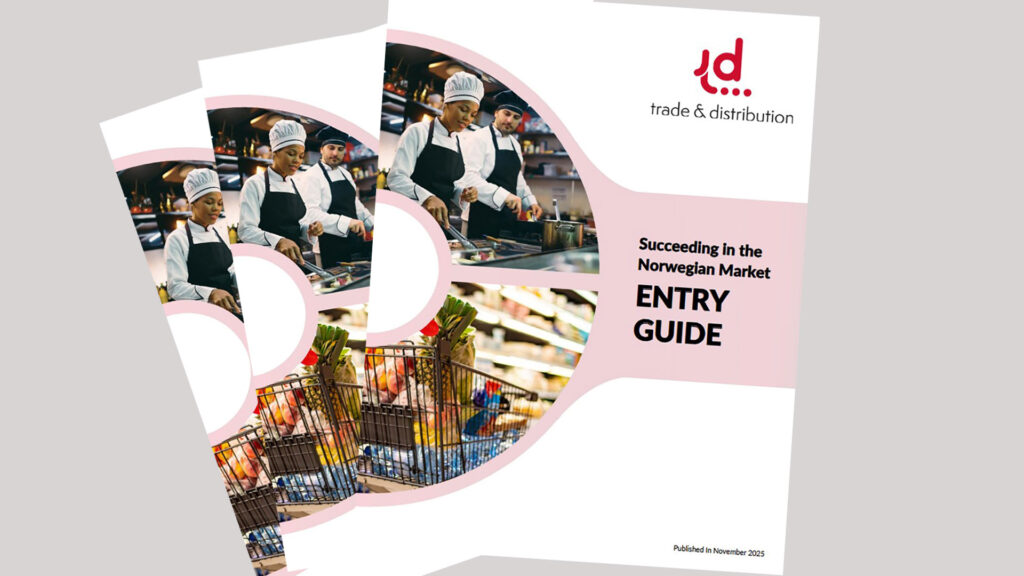
The market report ‘Succeeding in the Norwegian Market – Entry Guide’ is being launched by Trade and Distribution (TAD) in collaboration with UMAMI Arena. The report gathers key knowledge about the Norwegian market and makes it easier for foreign suppliers to understand framework conditions, consumer behaviour and official requirements.
The idea behind the report came when TAD learned that many of its customers were not well enough prepared before participating in UMAMI Arena in 2023 and 2025. Several lacked an overview of the Norwegian channel structure, regulations and consumer behaviour, and ended up with measures that had low effect.
“We wanted to create a framework that helps foreign actors understand Norway and stimulates curiosity about the Nordic region. Often they simply do not know how the market and various sales channels here work,” says Jon Bugge, Managing Director of TAD.

The report serves as a practical ‘entry guide’. It describes how the channels are structured, how customers shop and what requirements apply to labelling, language and customs. The goal is to give exporters a realistic picture of what is required to succeed.
A market with clear drivers
Succeeding in the Norwegian Market – Entry Guide shows that Norway is among the world’s most consolidated markets. In the grocery sector, three large chains are responsible for the majority of distribution, and 70% of the stores are in the low-price segment.
Something similar can be seen in foodservice (Horeca), according to Bugge, with ASKO and Servicegrossistene being the largest. However, the report points out the market has recently seen the entry of new actors, including KOLLY and DLVRY.
Within convenience (KBS), there is also a predominance of major players such as Reitan Convenience, NorgesGruppen and the historic fuel station companies Esso, ST1 and Circle K.
Bugge is concerned that players seeking to enter these different markets should be aware of what they can bring to the market.
“It is often challenging to bring new generic products to the Norwegian market. If you want to enter Norway, you must have a product with a clear identity and documented quality,” Bugge says.
He emphasizes that sustainability and quality are often closely linked in the eyes of Norwegian consumers.
“The Norwegian market has its own drivers. Norwegian consumers are extremely focused on quality, origin and sustainability. For Norwegian consumers, these are intertwined.”
At the same time, customs barriers, language requirements and special rules mean many products stop before they reach the store shelves. Succeeding in the Norwegian Market –Entry Guide describes the most common pitfalls and how players can avoid them.
Practical support for exhibitors
The launch of the report is closely connected with the new collaboration between TAD and UMAMI Arena. As the Import Partner for the trade fair, TAD will act as facilitator for foreign exhibitors and contribute with practical support before and during the event.
“We assist exhibitors with all the practicalities in advance: warehousing, freight, customs clearance and transit. We ensure that the goods arrive on time and are ready for use,” Bugge says.
He describes TAD’s role as a support partner for players encountering Norway for the first time.
“For many, this is their first interaction with the Norwegian market. Then it is not only about displaying who you are, but understanding how everything actually fits together.”
Torill Engelberg, Director of UMAMI Arena, believes the collaboration makes it easier to attract foreign exhibitors.
“We want to make it easy to choose Norway. With TAD on the team, foreign exhibitors receive professional support all the way, from logistics to regulation. This makes UMAMI Arena 2027 both richer and more attractive to international players.”
Long-term thinking yields results
Bugge believes that success in Norway requires patience and a strategic approach.
“Have at least a three- to five-year investment horizon. Norway is not a market that you just test out. It takes patience, but the upside can be great.”
He also sees signs that the market is changing. After several years with strong price awareness, chains are once more opening up for products with the potential to create growth and added value.
“Price pressure has been strong, but we believe the premium segment will grow as consumers see increased purchasing power within reach. The supermarkets are already seeing positive signs of this. Then both quality and sustainability will become more important again.”
Ambitions towards 2027
The purpose of Succeeding in the Norwegian Market – Entry Guide is to lower the threshold for foreign players and give embassies, chambers of commerce and export promoters a tangible tool in their dialogue with manufacturers.
“We hope the report will be a useful tool – a document that makes it easier for more players to invest in Norway,” Bugge says.

Torill Engelberg sums up the goal as follows:
“We want more foreign exhibitors, stronger relationships and an even more international arena in 2027. Working with Trade and Distribution gives us the tools to make it happen.”
Gain a complete understanding of Norway’s grocery, foodservice, and convenience markets — and secure your entry into one of Europe’s most attractive markets.
What’s inside the Entry Guide – see table of contents
For more information, contact: Trade and Distribution Norway AS, info@tradeanddistribution.no, tel +47 45 20 84 04.
UMAMI Partner: Trade and Distribution
UMAMI Arena has entered into a collaboration with Trade and Distribution to make it significantly easier for international players to introduce their products and services to the Norwegian market. Easier access to temporary import of the products to be presented and launched at UMAMI Arena is a first step.
Read more